- calendar_today August 14, 2025
.
Electric vehicle sales are losing momentum in the United States, with rising inventory and slowing demand making headlines. After more than a year of month-over-month gains, EV sales in the United States have now started to decline. Some automakers, like Genesis and Volvo, have already turned away from their EV offerings, and these two carmakers are far from the only ones rethinking their product plans.
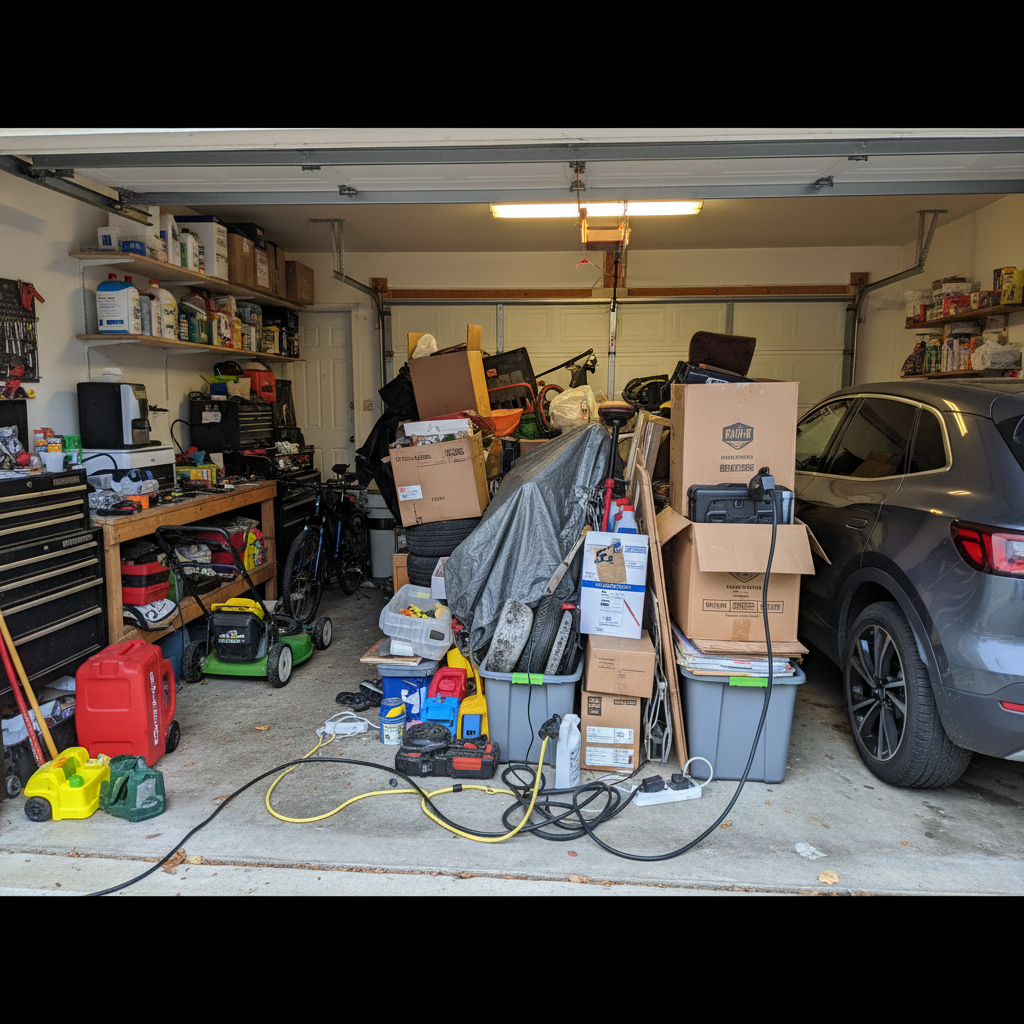
This is all happening as EV support at the federal level is in flux, with the current U.S. administration eliminating subsidies and vehicle pollution standards. But one obstacle to EVs may not be federal policy changes but something much closer to home: your garage.
Garages Matter to EV Adoption
Prolonged range anxiety and concerns over charging have long been seen as the primary obstacles to the mass adoption of electric vehicles. A new analysis from Telemetry Vice President Sam Abuelsamid of EV charging needs and potential in the United States digs deeper into the most critical issue for EV owners: where to charge.
A recent article from Abuelsamid for Green Car Reports delves into the limits of current U.S. infrastructure for home charging. Yes, we all hear about the major build-out of DC fast chargers, but here’s the reality: An estimated 80 percent of all EV charging is done using AC power. The single-family home is the default place for AC charging, which is typically level 1 (120-volt) or level 2 (240-volt).
At present, the National Renewable Energy Laboratory (NREL) found that 42 percent of Americans who live in a single-family home park near an outlet capable of level 2 charging. If homeowners were to clear out their garages, enabling more vehicles to park at home, and if they adjusted their parking habits to park near an outlet, then that number could expand to 68 percent. Abuelsamid tells Telemetry that “90 percent of all houses can add a 240 V outlet near where cars could be parked. Parking behavior, namely whether homeowners use a private garage for parking or storage, will likely become a key factor in EV adoption.”
If Americans were to open up their garages, the number of single-family homes that could technically charge EVs would expand from 31 million to over 50 million. When you also factor in homes where adding new wiring is possible, then the number of U.S. homes that could charge an EV jumps to over 72 million, Abuelsamid reports. That’s a number that far surpasses Telemetry’s EV Penetration forecast even at its high end, which projects a range of 33 million to 57 million EVs on U.S. roads by 2035.
That doesn’t mean that every home with a charger will have an EV, though. In addition to changing parking habits, U.S. homeowners must also deal with the challenge of electrical capacity to support charging. The same NREL study found that “almost 34 million” U.S. homes need electrical upgrades to support a 240-volt level 2 charger, which typically requires at least 30 amps of power. These range from simple rewiring jobs to full panel replacements, but even the simplest upgrades can run homeowners into the thousands of dollars.
Such realities don’t just undermine a key selling point of EVs, but also the fact that battery-powered cars may be more expensive upfront. Over the long term, EVs are projected to be more affordable than traditional internal combustion engine cars thanks to their simpler drivetrains and the lower cost of electricity relative to gasoline or diesel. But if charging infrastructure is needed at home, that total cost of ownership (TCO) starts to quickly approach the costs of a traditional gas-powered car or even overtake it, turning off buyers.
The Other “Single Family” Housing: Multifamily Dwellings
For single-family homeowners, that’s the challenge: assuming that EV owners park at home, how easy is it to install a charging outlet, or even have a place to park in the garage? The challenge is even more daunting for the 23 percent of Americans who live in multifamily dwellings, which include apartments, condos, and townhomes, among others. In this housing category, which is also sometimes called “single family” in real estate, the individual EV owner rarely has the ability to unilaterally install a charging outlet.
Instead, they must petition their landlord, building management company, or co-op board to install charging, and such installations aren’t always welcomed with open arms. In addition, the financial investment is typically much greater for these buildings than for individual homes. Take co-ops, for instance: to install a set of shared level 2 chargers, you typically have to upgrade the electrical panel first, a process that can easily cost millions of dollars. Wiring a dedicated charger to a distant parking space will only increase that price.
According to Telemetry’s 2023 US Residential Charging Report, multifamily EV adoption now outpaces single-family homes, but that’s largely due to the cost advantage of T-level 1 charging. Currently, around one million EV owners in the United States live in multifamily housing, but only 11 percent park close enough to an outlet to be able to charge at home. Some states have adopted or are in the process of mandating that 20–25 percent of new development parking spaces be EV-ready.
According to Telemetry estimates, between 6.7 million and 11.4 million total charging-capable parking spaces will be in multifamily dwellings by 2035. That total, while ambitious, still falls well short of expected demand. As such, multifamily dwellings are expected to be responsible for 29 to 35 percent of the public charger dependency by 2035. In other words, as more people drive EVs, they will still need more public chargers in the future.
Home charging, whether in a single-family home or multifamily dwelling, is not a silver bullet for America’s charging infrastructure needs. Telemetry data projects that between 11.7 million and 14.3 million EV owners who drive vehicles will still own single-family homes but will require public charging in 2035. The other 7.8 million to 8.1 million EV owners living in multifamily residences will also require public charging access.
The challenge with building out this infrastructure is two-fold. First, utility companies are already under immense pressure, with new AI data centers competing for their generation and distribution capacity, so the rollout of charging stations at both the neighborhood and large-scale commercial level will face growing pains and limitations.
In order to accommodate EVs, Telemetry projects that the U.S. will need between 523,000 and 586,000 DC fast chargers as well as between 1.5 million and 1.6 million level 2 chargers. Building and staffing those chargers at the level necessary for Americans to get where they need to go will be a logistical challenge, even without the continued surge in EV adoption we have seen to date.