- calendar_today August 10, 2025
In 2025, the United States implemented significant tariff measures, including a 104% tariff on Chinese imports and a 25% tariff on automobile imports from various countries (Reuters, April 3, 2025). These actions have profoundly influenced the U.S. investment landscape, affecting sectors such as technology, manufacturing, agriculture, and consumer goods.
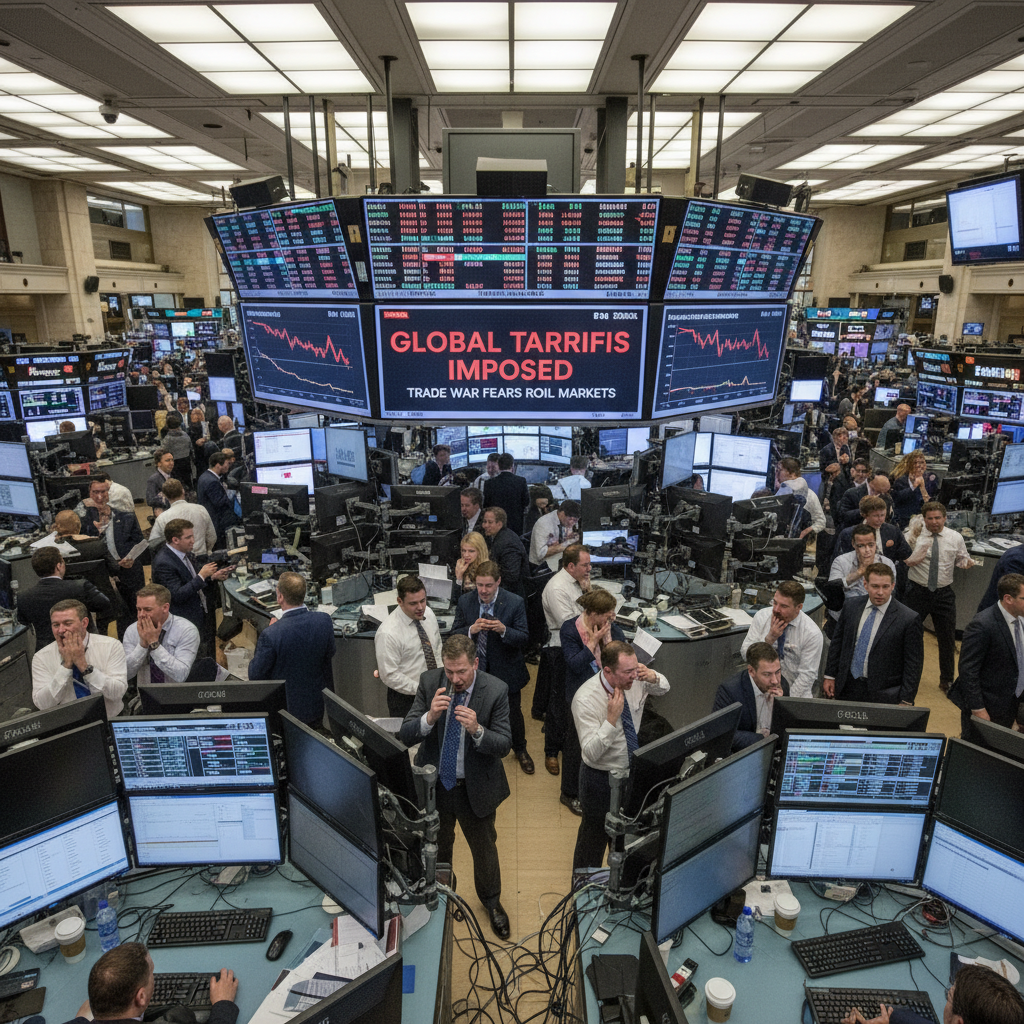
Within hours, global markets staggered. By the next morning, Wall Street had shed over 2,200 points, the S&P 500 dropped nearly 10%, and investors were left bracing for more volatility (The Guardian, April 5, 2025).
A Trade War Reignited
The 104% tariff on Chinese goods, announced on April 3, was just the beginning. Canada responded by matching the U.S. with a 25% tariff on auto imports, while China retaliated with a 34% tariff on all U.S. products (AP News, April 4, 2025).
“We will not be blackmailed,” a spokesperson for China’s Ministry of Commerce said in Beijing. “If the U.S. escalates, we will respond in kind.”
— Reuters, April 4, 2025
Where the Impact Is Hitting Hardest
1. Technology and Manufacturing
Few sectors have felt the sting of tariffs like technology. Taiwan Semiconductor Manufacturing Company (TSMC), which supplies chips to leading U.S. firms, faces a 25% import tariff. This led to a 15% drop in TSMC shares, erasing over $117 billion in market value in a matter of days (Reuters, April 9, 2025).
Apple also took a hit, with shares sliding 7% in Frankfurt trading. The company is reportedly reevaluating major parts of its global supply chain (Reuters, April 3, 2025).
“We’re seeing a fundamental rethinking of global logistics,” said James Rowley, a trade analyst at Deloitte. “Tariffs are forcing companies to consider reshoring, even if it’s more expensive.”
2. Agriculture & Raw Materials
U.S. farmers, already struggling with years of inconsistent export demand, are now grappling with a 34% Chinese tariff on American agricultural products, key exports like soybeans, corn, and pork.
According to the U.S. Department of Agriculture, projected agricultural exports for FY2025 stand at $170.5 billion, a slight increase from 2024 but far below pre-trade-war forecasts (USDA Outlook Report, March 2025).
“We’re caught in the middle of a geopolitical chess game,” said a Kansas wheat grower. “But we’re the ones getting checkmated.”
3. Automotive and Consumer Goods
The 25% tariff on foreign automobiles has frozen momentum in the auto industry. Sales are expected to drop by 2 million units this year as car prices rise, according to AutoForecast Solutions (Reuters, April 7, 2025).
Volkswagen’s Audi division is reportedly holding cars at U.S. ports, waiting for clarity, while Ford and GM are reconsidering production strategies amid ongoing stock declines (Reuters, April 7, 2025).
Investor Sentiment: Volatile and Cautious
Investors are nervous. Following the tariff announcements, the Dow Jones dropped 2,200 points, and the S&P 500 flirted with bear market levels (Bloomberg, April 8, 2025). The NASDAQ, heavy with tech stocks, has also seen sustained losses.
Meanwhile, gold prices rose 1% to $3,010.39 per ounce as cautious investors sought safe-haven assets (Reuters, April 9, 2025).
“We’re in wait-and-watch mode,” said Erin Simmons, strategist at JPMorgan Asset Management. “No one wants to catch a falling knife in this climate.”
Short-Term Strains, Long-Term Uncertainty
In the short term, consumers will likely face higher prices on a broad range of products, from smartphones to SUVs. Economists warn that if the tariffs persist through Q3, the U.S. may face stagflation—high inflation with stagnant growth (Business Insider, April 6, 2025).
In the long term, supporters argue that tariffs may revive U.S. manufacturing and strengthen domestic supply chains. Critics counter that the global economic disruption and risk of recession outweigh those potential gains.
What Investors Should Watch
As 2025 unfolds, tariffs are no longer a footnote in economic policy, they’ve become a driving force behind market sentiment and portfolio decision-making. From equities and commodities to real estate and farmland, investors are reevaluating where and how they place their bets.
The smart capital is gravitating toward domestically anchored sectors: U.S. manufacturing, infrastructure, renewable energy, and reshoring-oriented industries. At the same time, exposure to globally dependent tech and import-heavy consumer goods is being cautiously reduced. Yet, with every new tariff, countermeasure, or political maneuver, the rules of the game keep evolving.
In a climate where uncertainty is the only constant, one thing is clear: agility, diversification, and a keen eye on policy shifts may prove more valuable than ever. For investors navigating the turbulence of 2025, the ability to adapt isn’t just smart—it’s essential.
Stay ahead of the curve. Subscribe to our newsletter for weekly insights, expert commentary, and real-time updates on how global trade is shaping the U.S. economy.