
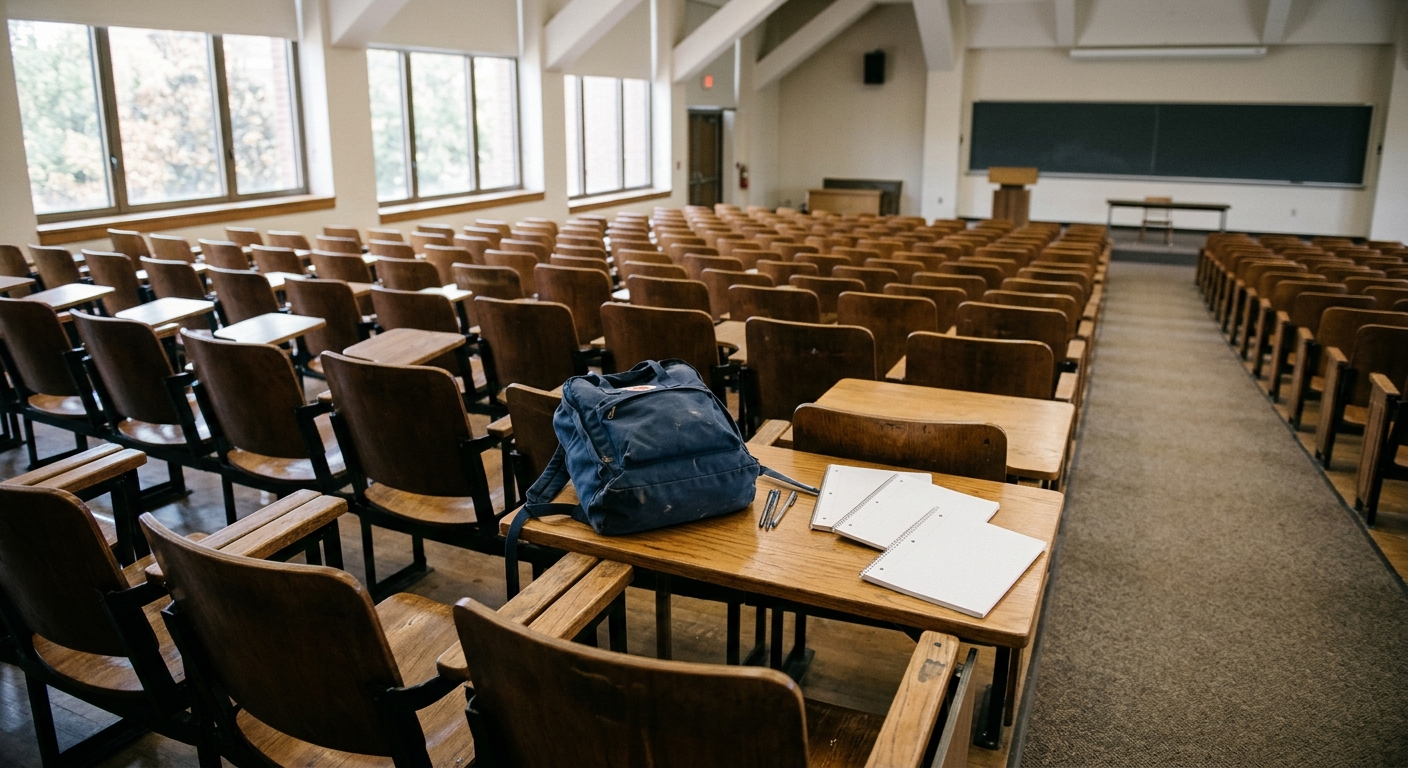
AI-generated illustration; not a photograph of the reported event.
- calendar_today November 16, 2026
International Enrollment at U.S. Universities Declines
The number of international students attending U.S. universities has decreased, according to new data released by the Institute of International Education. The survey, published Monday, highlights a 9% decline in overall international enrollment this fall compared to the previous year. Additionally, the number of new international students entering the United States for the first time dropped by 15%.
Impact of Immigration Policies and Environment
The reduction in international students is occurring as the Trump administration introduces stricter immigration policies affecting higher education. Veena Dubal, general counsel for the American Association of University Professors, said, “It feels like an unsafe place. That’s the message that the Trump administration has been sending to families all over the world and they’re listening.”
College leaders consulted by the Institute pointed to the visa application process and travel restrictions as key factors. Among more than 800 surveyed institutions, 88% identified the visa process as a challenge, while 70% cited travel limitations.
Optional Practical Training and Proposed Fees
Another factor in the enrollment drop is uncertainty around the Optional Practical Training (OPT) program. The Department of Homeland Security has proposed a $70,000 fee for each OPT participant, a rule not yet finalized but expected to face legal challenges. Participation in OPT declined by 6% this fall, according to the survey. DHS efforts have also included terminating the legal status of thousands of international students and detaining or deporting many individuals.
This summer, a rule was finalized to prevent international students from remaining in the U.S. for more than four years without federal government approval, though a judge has temporarily blocked this policy.
DHS Secretary Markwayne Mullin stated that these changes were intended to address loopholes exploited by international students to prolong their studies.
Economic and Institutional Effects
The decline in international student enrollment carries financial implications. NAFSA and JB International, an education technology company, reported that international student contributions to the U.S. economy dropped by $2.4 billion this fall. U.S. colleges and universities often rely on tuition revenue from international students, and the reduction has created significant budget shortfalls at some institutions.
Cleveland State University, for instance, saw a 46% decline in international enrollment over two years—from 1,542 students in fall 2025 to 828 this fall—with fewer than 50 new arrivals in the latest semester. Provost Nigamanth Sridhar estimated a resulting budget impact of $2 million to $4 million. Sridhar, who came from India on a student visa, observed that international education had a personal significance for him.
Trends and Global Competition
The report identified a 15% drop in international graduate enrollment, compared with a 3% decline at the undergraduate level. Decreases were also noted among students from India, traditionally the largest sender of students to the U.S.
Mirka Martel, head of research for the Institute of International Education, pointed out that growing global competition and rising U.S. tuition costs further dissuade potential applicants.
Fanta Aw, executive director and CEO of NAFSA, said that uncertainty about research funding and the dismantling of federal grant processes under the Trump administration have also influenced students' decisions. "They’re saying to themselves, ‘Too much uncertainty in the United States. It’s too difficult, and you know, more importantly, we have many more choices today than we did 10 years ago. Why subject ourselves to this?’" Aw explained, noting an increasing interest in alternate destinations like China.
Future Outlook and Policy Developments
Sarah Spreitzer, vice president at the American Council on Education, commented that significant immigration legislation is unlikely to pass while President Trump remains in office. However, Spreitzer suggested that congressional oversight could limit the impact of future policies targeting international students and provide greater certainty.
Despite the U.S. remaining the top destination for international students, ongoing policy changes and global competition are shaping new trends in higher education.
Related coverage
Source: abcnews.com.


