- calendar_today August 15, 2025
Species at 30: A Flawed but Fascinating Sci-Fi Relic
Last month, the Hollywood community lost one of its most indefatigable badasses: actor Michael Madsen. Though most know him for his signature performances in Reservoir Dogs, Kill Bill, and Donnie Brasco, his is an extensive filmography filled with other fan-favorite roles. It’s easy to overlook his brief turn as a black ops mercenary sent to hunt down a half-human, half-alien hybrid in the mid-’90s monster movie Species. That’s too bad, because as the film nears its 30th anniversary, it might be a good time to revisit this bonkers entry in a decade flush with monster movies and alien xenophobia.
Species has a lot going for it that its reputation might not reflect. Helmed by No Way Out and The Bounty director Roger Donaldson, the 1995 film was a curiously out-there blend of horror, action, and quasi-science fiction. The basic premise starts with two transmissions that the U.S. government receives from outer space. The first includes detailed information on a new source of fuel; the second provides an exact formula for how to splice alien DNA and human DNA. Need we say the government followed through? Guided by the secretive Dr. Xavier Fitch (Ben Kingsley), an operation is set up to create a human-alien hybrid. Her name is Sil (in her childhood years, played by Michelle Williams), and when she’s unleashed on the world, she’s a raging killer.
Species was a mixed bag when it hit theaters, but something about the movie—a certain pulpy, B-movie aesthetic—won over audiences in the mid-’90s. It opens with an extended montage of urban chaos and catastrophe before it even establishes the plot. But it’s only a few minutes in, and we get a look at what we’re dealing with. Sil has grown up. She was created by Fitch to be a docile organism, easily controlled. Instead, his experiment has backfired in the most obvious way: She matures at an accelerated rate, and in three months, Sil now looks and acts like a 12-year-old girl. But there are signs she’s different. Her nightmares are violent, and the signs point to her being unpredictable and possibly undeterred. When Fitch decides to kill her off and terminate the experiment by releasing cyanide gas into her containment cell, Sil manages to escape. So begins the hunt.
The hit team Fitch assembles to track her down is an amalgam of professional archetypes with one or two twists. Alongside Madsen’s straight-talking mercenary, Preston Lennox is Dr. Laura Baker (Marg Helgenberger), a molecular biologist; Dr. Stephen Arden (Alfred Molina), an anthropologist; and Dan Smithson (Forest Whitaker), a vaguely angry empath who can sense Sil’s emotional and mental state. The group crosses the country, then to Los Angeles, by which point Sil has reached maturity and is played by Natasha Henstridge. Her first order of business as an adult is to find a mate. Sil is seductive, clever, and constantly adapting to her environment. When not solving puzzles in Fitch’s old lab or learning from them, she’s picking up random victims in the streets of Los Angeles. She’s a vicious killer in broad daylight: Her first victim is a vagrant on a train; then she kills another in a nightclub. When she’s not randomly killing to get information, she’s killing people who get in her way. Before long, her next victim is her would-be lover, whose own fate seems to be sealed.
Seductive, Deadly… and Visually Compelling
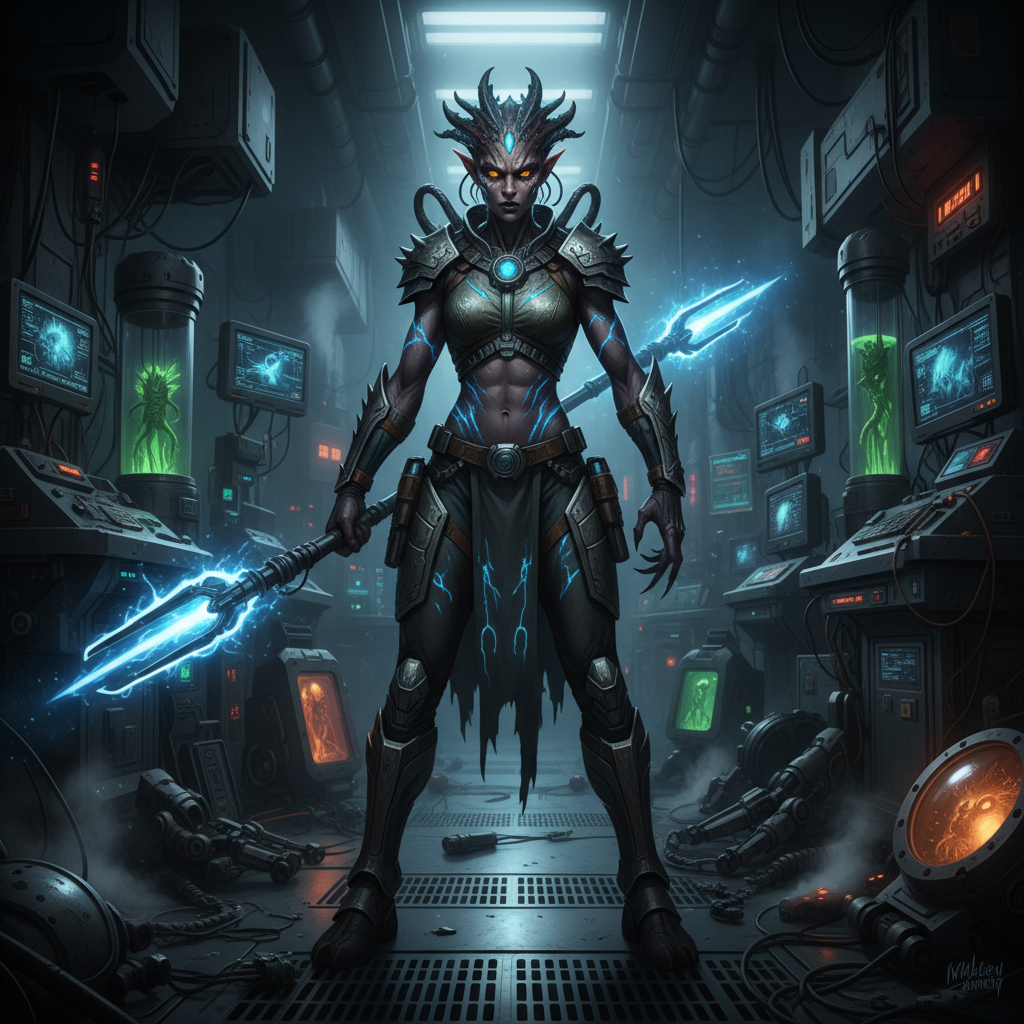
Species’s other most interesting ingredient was the special effects makeup, crafted by famed surrealist artist H.R. Giger, who designed the original alien in the first Alien film. Giger conceived of Sil as “an aesthetic warrior, also sensual and deadly.” Giger described Sil’s final form as “transparent” in interviews, with skin that “looks like a glass body, but there’s a carbon inside.” Giger was unable to fully realize his ambitions to create several different stages of Sil’s alien evolution, though he was able to incorporate at least one transformation cocoon and a large, maternal alien form in the third act.
Giger never loved Species, believing that the film, both in concept and execution, leaned too hard on his original Alien film, especially during the final act (Species‘ human-alien birth sequence he felt was a rip-off of the “chestburster” sequence from Alien) and design work (the “punching tongue,” for example). In the movie’s defense, however, the effects work is nothing if not impressive and impactful. Giger created multiple pieces of concept art, all of which made the final cut. He was responsible not just for the alien itself, but also created the exploding gas canisters Madsen’s team uses to subdue Sil. He even showed up on set and demanded that Sil be killed off with a bullet to the head instead of the film’s original plan, which Giger said was too derivative of Terminator 2 and Alien 3.
A Disjointed Film with Big Ideas
Species had good intentions, but it also suffered from some glaring flaws. The screenplay by Donald Frankfeldt Feldman (best known for directing and writing the gothic slasher drama Near Dark, also a 30-year-old movie) was full of flat dialogue and poorly drawn characters. Madsen and Helgenberger make a decent onscreen pair, but that’s because they’re given the fewest talking parts, leaving Kingsley and Whitaker to flail about in dialogue. The more significant problem is that the characters represent several fascinating, interlocking concepts but don’t quite have the depth to reflect them. Kingsley’s Xavier Fitch has a fleeting moment when he posits that Sil may have an instinct that “all life must go on,” an evolutionary need to procreate with humans. There are fun moments, like Madsen’s Lennox getting grilled by an ICE task force, but as a rule, the film is on the more straightforward, pulp side of pulp.
The themes themselves were drawn from a surprising source: an article by sci-fi writer and author Arthur C. Clarke about the human race never being contacted by extraterrestrial life. Clarke hypothesized that life from other planets was almost too far away for our current civilization to make contact. So he questioned: What if an alien species got in touch with us using a blueprint to terraform our planet, rather than a message in a bottle? In other words, what if extraterrestrials seeded our planet with the means to create an organic life-form? Something aggressive, purposeful, and sentient? For Feldman, the idea was pure magic, and he used it as a framing device for Species. Maybe, Feldman wondered, extraterrestrials could contact Earth with blueprints to create something organic, not an inorganic space-faring craft. Something invasive, made out of Earth’s DNA.
The final result was a movie that doubled as both a creature feature and a cautionary tale. It never will reach the status of the films it bled from so flagrantly (Alien, Terminator 2: Judgment Day), but it got something right and made a cult audience in the process. The curious intersection of Henstridge’s otherworldly performance, Madsen’s character actor presence, and Giger’s unforgettable creature design results in a ’90s sci-fi curio that’s easy to see now that it’s approaching 30.
Species is a time capsule of what science fiction looked like when style overcame substance in many ways and of the memorable and unlikely roles that shaped an actor’s career, like Michael Madsen’s, in the process.