- calendar_today August 12, 2025
.
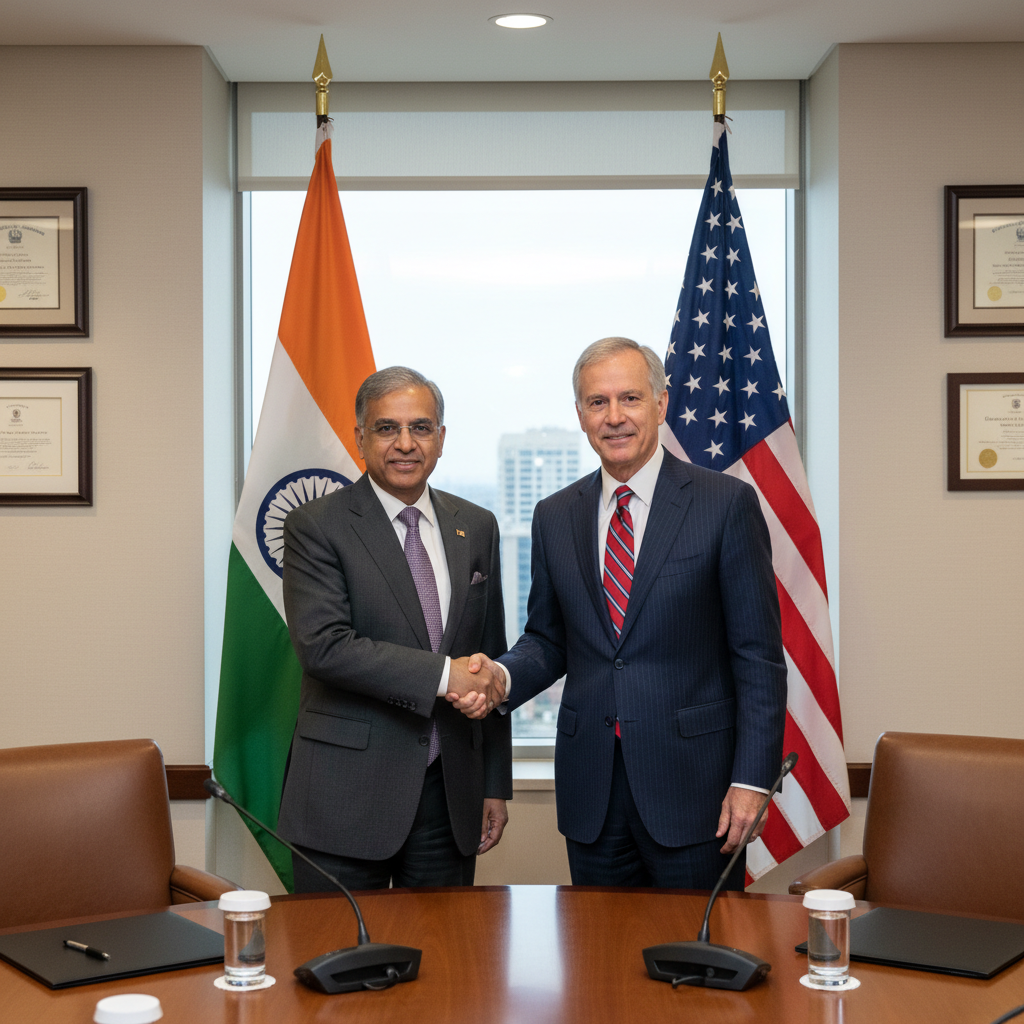
For 25 years, Washington and New Delhi forged what was considered one of the most successful strategic partnerships of the post–Cold War world. Now that the relationship is at risk of collapsing as trust between the two governments runs low on tariffs, oil, and geopolitical realignment.
Evan Feigenbaum, a South Asia expert at the Carnegie Endowment for International Peace, said bluntly. “We’re in a situation in the U.S.-India relationship where the premises and assumptions of the last 25 years — that everybody worked very hard to build, including the president in his first term — have just come completely unraveled,” he said. “The trust is gone.”
Trust between the two governments has eroded rapidly since U.S. President Donald Trump slapped wide-ranging tariffs on Indian goods earlier this year, lambasting New Delhi’s refusal to cut back its purchases of Russian oil even as Moscow continues to fund its invasion of Ukraine. The initial 25 percent tariff is due to double to 50 percent on August 27. Far from forcing India to change course, the move seems to have pushed New Delhi closer to Moscow and even Beijing.
India’s national security adviser visited Moscow last month, and Foreign Minister Subrahmanyam Jaishankar returned from high-level talks with his Russian counterpart this week. Chinese Foreign Minister Wang Yi also wrapped up a visit to New Delhi, and Prime Minister Narendra Modi is set to travel to China in the coming weeks for the first time in more than seven years. Russian President Vladimir Putin is also likely to welcome Modi in Moscow before the end of the year. Kugelman said that India’s overtures have substance.
Indian public opinion has turned against what it perceives as American attempts to meddle in its sovereign right to choose energy partners. “They’re signaling very clearly that they view that as interference in India’s foreign policy, and they are not going to put up with it,” Feigenbaum said.
After some hesitation in the early days of the war, India’s state-run oil refiners returned to the Russian market with the lure of six-to-seven percent discounts. The result has been an energy gamble. Russian oil currently makes up 35 percent of India’s crude imports, up from 0.2 percent before the war in Ukraine. In response, Moscow is doubling down, opening up to Indian interest. “We have potential for the export of Russian LNG [liquefied natural gas],” Deputy Prime Minister Denis Manturov said in New Delhi.
No Soft Line
Michael Kugelman, a South Asia analyst in Washington, D.C., noted that Trump’s tariffs are not the only reason for India’s hardening line against Washington’s stance. “We’ve seen indications for almost a year of India wanting to ease tensions with China and strengthen relations, mainly for economic reasons. But the Trump administration’s policies have made India want to move even more quickly,” he said.
Some of New Delhi’s maneuvering may be performative, a “message” sent to Washington, as Feigenbaum put it. But other aspects of India’s warming relations with Russia are much more serious. “India is going to double down on some aspects of its economic and defense relationship with Russia — and those parts are not performative,” Feigenbaum said.
India was already cutting its defense purchases from Russia even before the war in Ukraine, buying more U.S., French, and Israeli weapons. With the invasion of Ukraine, New Delhi cut Moscow’s share of its arms imports by a third, buying only one-quarter of its military systems from Russia compared to a majority in previous years. After February, however, energy trade with Moscow has expanded.
Kugelman said it is “buying into the message” that “the U.S. can’t be trusted, whereas Russia can — because Russia is always going to be there for India no matter what.”
Modi’s Advantage
Domestically, Modi has found an opening in which to portray himself at home as an international defender of national sovereignty. He has made much in public appearances of his priority to protect the livelihoods of farmers, small and medium-sized businesses, and young workers and graduates. For Modi, who has seized control of India’s narrative since his first election victory in 2014, the message has strong domestic political appeal.
Kugelman said that India had already made important concessions to Washington on tariffs, worker repatriation, and humanitarian grounds, and the Indians could give no more. “Because of those concessions, India needs to be careful about signaling further willingness to bend. This is one reason there was no trade deal — Modi put his foot down,” he said.
In the United States, the rhetoric is getting shrill. In the Financial Times this week, former White House trade adviser Peter Navarro described India’s decision to purchase Russian oil as “opportunistic” and “deeply corrosive.” He argued that the tariffs were necessary to pressure India “where it hurts — its access to U.S. markets — even as it seeks to cut off the financial lifeline it has extended to Russia’s war effort.”
The lesson New Delhi is sending Washington is clear. India will do as it wishes, even if it means leaning on the Americans’ geopolitical rivals.