- calendar_today August 20, 2025
On Thursday, researchers at Carnegie Mellon University unveiled a groundbreaking innovation: LegoGPT serves as an artificial intelligence system that converts basic text instructions into physically stable Lego structures. This innovative system creates Lego designs based on textual descriptions and guarantees that they are buildable brick by brick through human construction or robotic assistance.
The paper titled “Generating Physically Stable and Buildable Lego Designs from Text” by the researchers was published on arXiv. The researchers built a comprehensive dataset of stable LEGO designs with captions, then trained a large language model to learn brick placement through next-token prediction.
The model which received extensive training, can produce LEGO constructions from a range of text prompts including “a streamlined elongated vessel” and “a classic-style car with a noticeable front grille.” The designs produced currently showcase simplicity through basic shapes created with a minimal selection of bricks while their fundamental achievement resides in their structural stability.
Addressing the Limitations of Existing 3D Generation
Under Ava Pun’s leadership, the research team identified a major obstacle in 3D generation technologies. Existing models generate complex geometric designs but frequently encounter problems during physical creation. The researchers noted that without adequate support structures, parts of the design can either collapse entirely, remain suspended with no contact points, or stay isolated from the rest of the model.
LegoGPT stands out from earlier autonomous Lego modeling methods through its unique ability to generate step-by-step building instructions that ensure Lego structures remain intact. The project website contains demonstrations that display the system’s remarkable capabilities.
How LegoGPT Works: From Language Model to Brick Placement
The core innovation of LegoGPT comes from its adaptation of technology used in large language models (LLMs) that power systems like ChatGPT. LegoGPT makes use of “next-brick prediction” technology rather than traditional “next-word prediction” systems. The Carnegie Mellon team achieved its goal by fine-tuning Meta’s instruction-following LLaMA-3.2-1B-Instruct language model.
The team enhanced the brick prediction model by adding a specialized software tool for checking physical stability. The tool applies mathematical models to simulate how gravity and structural forces affect new Lego designs.
The development of LegoGPT involved training with a new dataset named “StableText2Lego” that includes 47,000 confirmed stable Lego configurations and their corresponding descriptions written by OpenAI’s GPT-4o AI model. The dataset’s structures received a comprehensive physics analysis to confirm their potential as real-world constructions.
The LegoGPT system creates exact sequences of brick placements for constructing designs. The system validates that every additional brick to the design simultaneously prevents collisions with existing bricks and stays within the established construction boundaries. After finishing the design phase, the mentioned mathematical models check whether the structure can remain upright without collapsing.
LegoGPT’s success depends heavily on its “physics-aware rollback” technique. When the system recognizes a design section that would collapse in real-world conditions, it finds the first unstable brick and backs up to remove that brick along with all following bricks before trying a new construction method. The scientists confirmed that the method proved essential because it increased stable design percentages from 24 percent without it to 98.8 percent when using the complete system.
Real-World Validation: Robots and Human Builders
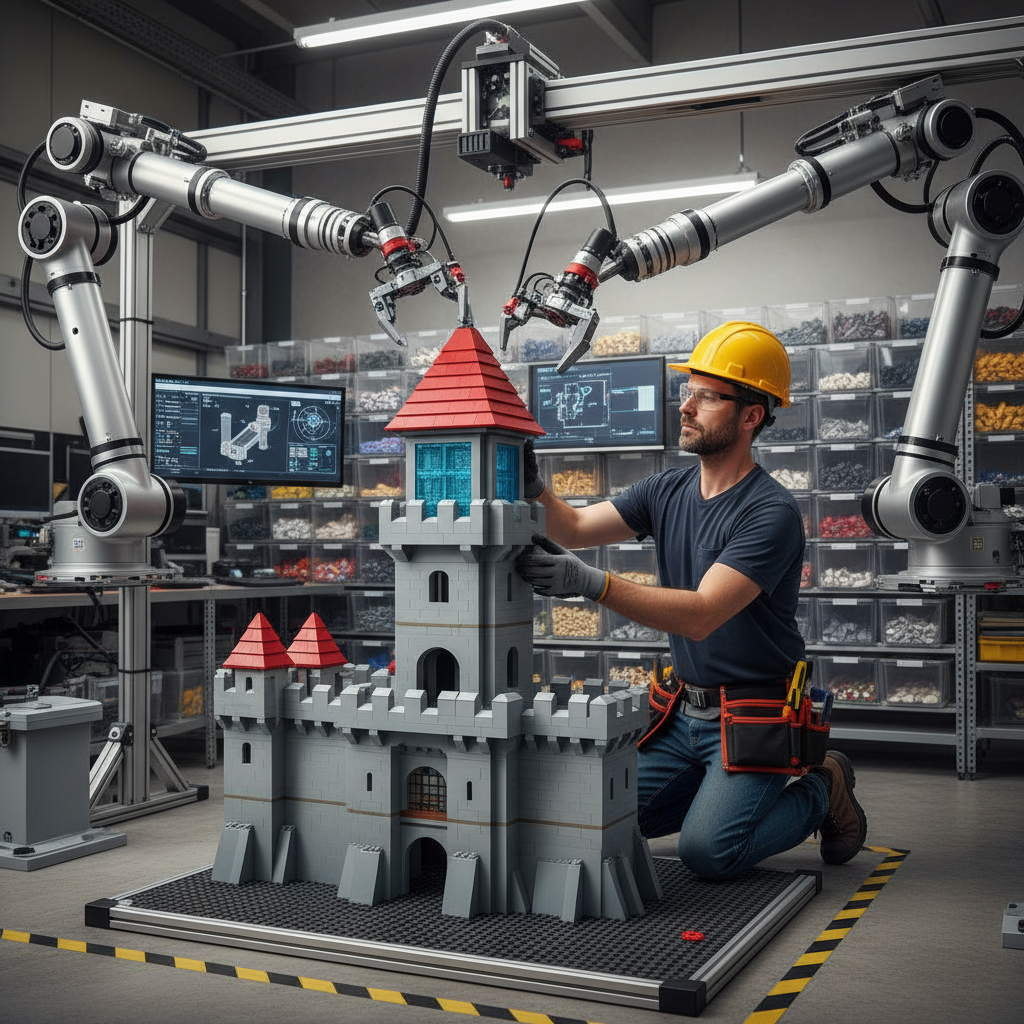
The researchers carried out real-world assembly experiments to thoroughly evaluate the practical viability of their AI-generated designs. Researchers used two robotic arms with force sensors to accurately pick and place bricks following LegoGPT-generated instructions.
Human builders participated in assembling certain AI-generated models manually, which demonstrated LegoGPT’s ability to generate realistic Lego designs. The research team confirmed that their experimental results demonstrated LegoGPT’s ability to create stable, diverse Lego designs that are both aesthetically pleasing and closely match the input text prompts.
Among AI systems developed for 3D creation, such as LLaMA-Mesh and other 3D-generation models, LegoGPT achieved the best results for structural stability through its exclusive focus on structural integrity.
Looking Ahead: Expanding the Lego Universe
The latest version of LegoGPT has achieved impressive results but still contains operational constraints. The system operates within a 20×20×20 building space and uses only eight standard types of bricks. The team confirmed that their method operates using only a fixed collection of standard Lego brick types. Our future work aims to grow our brick collection to encompass a wider variety of brick sizes and styles, including slopes and tiles.
LegoGPT marks an important advancement at the cross-section of artificial intelligence technology and tangible creation. Future AI systems will gain the ability to turn digital designs into tangible products through stability-focused buildability, which creates new opportunities across robotics and manufacturing while also enhancing the fun aspect of Lego construction.