
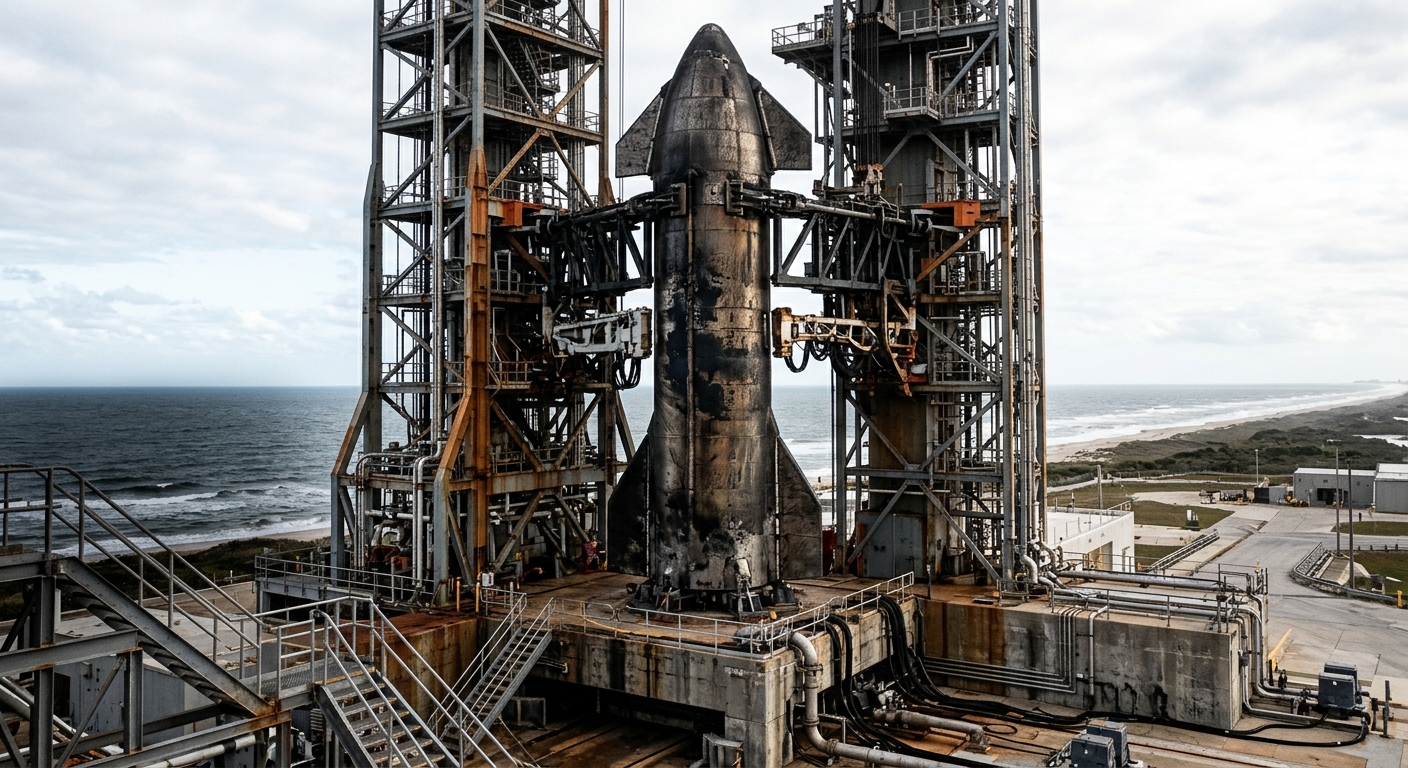
AI-generated illustration; not a photograph of the reported event.
- calendar_today November 14, 2026
SpaceX Completes First Orbital Starship Recovery
SpaceX achieved a significant milestone in space exploration on November 14, 2026, successfully recovering its Starship rocket from orbit after a 22-hour mission. The uncrewed vehicle endured the intense heat of atmospheric reentry and performed a dramatic landing sequence, culminating in a catch by mechanical arms at the company's Starbase facility on the Texas Gulf Coast.
Spectacular Descent and Catch at Starbase
Throngs of SpaceX employees cheered as the Starship, after transitioning through Earth's atmosphere, restarted three out of its six methane-fueled Raptor engines. This maneuver flipped the vehicle upright, allowing it to slow dramatically near its launch pad where two massive robotic arms awaited. The robot arms closed around the rocket, securing it in place just as its engines shut down. Cameras aboard the rocket captured dramatic views of the descent, giving viewers an up-close look at the Texas Gulf Coast during the landing sequence.
SpaceX commentator Jessie Anderson described the event as, "one of the most incredible and historic engineering feats of all time," congratulating the entire SpaceX team and their supporters for the accomplishment.
Significance for Reusable Rocket Technology
This mission marked the first time SpaceX recovered a Starship from orbit, with previous flight tests ending in planned ocean splashdowns. The feat is a critical advancement in the company's quest to create a fully reusable orbital-class rocket. SpaceX founder Elon Musk has frequently stated that such technology is essential for lowering the cost of launching payloads to Earth orbit, the moon, and potentially Mars in the future. Standing 407 feet tall and powered at liftoff by 33 Raptor engines generating 16 million pounds of thrust, Starship represents the most powerful rocket ever built.
Super Heavy Booster and Ongoing Development
Starship was launched with a Super Heavy booster, also from Starbase, on Friday before the successful recovery event. Although SpaceX had managed to recover first-stage boosters on three prior test flights, this particular Super Heavy booster could not return to land due to a guidance issue and ultimately exploded moments before an intended ocean splashdown. Musk commented on social media platform X that this loss was due to "slight underperformance of engines," emphasizing that improved designs are already in production or testing and that the setback would not impact the broader timeline for operational, fully reusable Starship flights.
Technological Challenges and NASA Interest
During its return, the Starship upper stage provided clear camera footage as its heat-shielded belly glowed from atmospheric friction. The vehicle crossed the Baja Peninsula and northern Mexico, executing a complex descent before its engines reignited for a final, controlled vertical flip and precise capture by the pad's robotic arms.
SpaceX commentator Dan Huot highlighted the achievement, stating, "That was the holy grail of spaceflight, plummeting through fire to be snatched out of the air by steel." However, SpaceX must continue refining its technology to prove the reliability necessary for future crewed missions, including autonomous orbital refueling—a capability necessary for NASA's planned lunar lander operations. NASA plans to use a derivative of Starship for its 2028 Artemis mission, though it remains open to Blue Origin's Blue Moon Mark 2 lander if development timelines shift.
What Lies Ahead for SpaceX and Starship
SpaceX's roadmap includes conducting orbital fueling tests in upcoming Super Heavy-Starship flights. While development has taken longer than first anticipated, the company's latest achievement demonstrates continued progress toward routine, fully reusable launches. The implications for space exploration, reduced costs, and future missions to the moon and Mars remain significant as the Starship program advances.
Source: cbsnews.com.


